
A journey through Dwelling Places
with Guest Contributor Ľuboš Slovak

This is the story of Ľuboš’ journey through the Dwelling Places inquiry. It begins as he moves to a new Dwelling Place, full of high hopes, not only of settling down but also of drawing together a community that will ‘save’ this piece of Land from potential ‘development’. In the weeks of the inquiry, he confronts his feeling that he lacks personal discipline, realizes some of the foolishness of what he sees as his ‘messianic ambitions’, and learns to be attentive to the moment. Ľuboš writes, “So I have reduced my practice to the bare minimum: turning up; paying attention. Isn’t that a form of invocation in itself, anyway?” This insight echo’s Dave’s reflections in Oak and Water: “You’ve just got to turn up. You’ve got to turn up and you’ve got to show up – or I have to turn up and show up – in a transparent, innocent way”. With this open attention, Ľubǒs develops a more reciprocal relationship with the Land: “… the place felt my gift and quivered with delight”.
This summer, I moved to an old mill, with a small brook next to it, in the Moravian Karst area of the Czech Republic I have known this place for a few years already, visiting from time to time, and this year I have been lucky enough to move here. I'm trying to get a group together who would buy the place, settle in, and care for it. This connects with my goals in this inquiry. I would like to get to know the place better, because I'm new here; and to develop practices that would develop a deeper, caring relationship to the place.
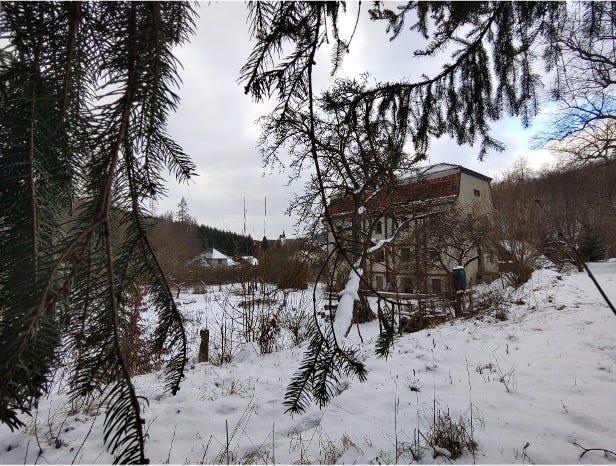
I work at a university. I teach many courses, including on deep ecology, but my normal professional life tends to disconnect me from the place I live, from the land, sometimes from myself and my body, because a lot of work that I do is just behind the computer. I find it a challenge to make practices of relating to the land as part of everyday life so that they are not disconnected from my work life and vice versa.
When I visited the mill before I moved in, I was enchanted by it. But quickly after moving in, the spell was broken by the deep rumble of trucks, steady whir of cars and shrill roar of motorbikes that calm down only late at night. I was so sad and frustrated that I was reluctant to even go out into the garden. Over time, I have learned to see the noisy road and pollution as wounds of the land. They are a reason to give the land more loving attention, not less. The hills, foxes, and beeches around, the apple and walnut trees, blue tits and blackbirds in the garden don’t deserve my ignorance because of the road and its traffic.
I slowly started to spend time in the garden with a more open heart. I didn’t have any regular practice established yet, didn’t know how to start. I started noticing the birds getting livelier as the sun rays were getting stronger every day.
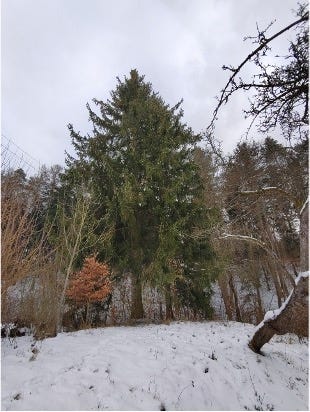
After a while, I finally tried to establish a ceremonial practice. I walked around the whole plot of land, stopping at places that seemed significant, making small offerings: at both main gates, at the walnut tree, the very old linden next to the house entrance, small gate leading to the forest, at the small pond next to the road. I was able to take in the full size of the plot and discover spots I wasn’t even aware of before. One was a large spruce tree in the furthest corner. I wondered how I had never noticed it before!
The tree drew me close, in awe of this proud guardian of the boundary. It sits atop a very old earth-filled dam that in the past held the water for the mill. The small creek that fed the pond runs just past the tree, gurgling along and forming the natural bounds of the garden, an interface where my dwelling place meets the home of the foxes, wild boars and roe deer.
I was able to sit directly under the tree and immediately knew this will be my sit-spot. The garden is otherwise very open, there are no secluded places, but here, with my back to the wide trunk and looking through the shrubs, I felt safe and hidden enough to be able to properly relax.
I performed a small ceremony to help myself relax even more while becoming more present in my body and through it in the place. It takes time for me to shift into this kind of open attention. Eventually, I was able to better notice the flow and rhythms of the place. I notice the silent patience of the trees; they have seen many people living in the house, working on the mill. The old Linden and maybe even this Spruce have definitely seen the pond while it still existed. They saw people bringing grain on horse-drawn carts coming in through the upper gate and others hauling the flour through the lower one. At that time the roads where probably merely dust streets of a small merchant town
In the following weeks, I became flooded with doubts and frustration about myself and the Dwelling inquiry. I had nothing to report or reflect on; no meaningful encounters with my Dwelling Place. Or any other place for that matter. And my mood and state of mind was anything but slow, present and attentive. Seeing other people finding the time and context to come into deeper contact with the living world around, even when busy or traveling, made me feel miserable in two ways. On one hand I felt that I’m failing the group, not contributing my part properly. On the other, this situation highlights for me how I (again) fell into the trap of my destructive work ethic, which I’ve been trying to change for the last 15 years. The attitude that is so neglectful towards myself and other aspects of living and in consequence towards the living world as well. Do I even know what ‘dwelling’ really feels like?
Then one evening, immersed in this rather depressing mixture of feelings and thoughts (with an occasional judging voice saying how pathetic it all is), I got off the bus onto the night road in my village. I remembered such late returns to my previous dwelling place, where I always felt a deep calm and gratitude. As the mood from the memories seeped into my body, something unexpected happened. I slowed down and noticed that contemplative quiescence that embraces the land at the end of a soft rain. As I neared the patch of land and the old mill I now call home, I saw the towering wooded hill just behind it, and sensed the haze rising from the forest on the slope. I love the dark, and as I breathed in the moist, dark air, a profound feeling of gratitude spread spontaneously through my body. I guess this is what grace feels like.
After this, I started to experiment with other ways of being open to the world. I attend more to the plants in the garden as it wakes up in the Spring, and to the birds as they arrive and start to sing. The place is transforming, awakening. I’m wondering what I’m going to encounter in the following weeks. It seems ever more inviting, but at the same time it reminds me that I’m still a very fresh newcomer. As if it said: “Wait until you see my other faces! I have plenty!” There are probably nooks I haven’t noticed yet; plants that haven’t sprouted yet; maybe even birds that haven’t arrived yet. It fills me with humility and wonder! “I will try to be a patient student,” I pledge.
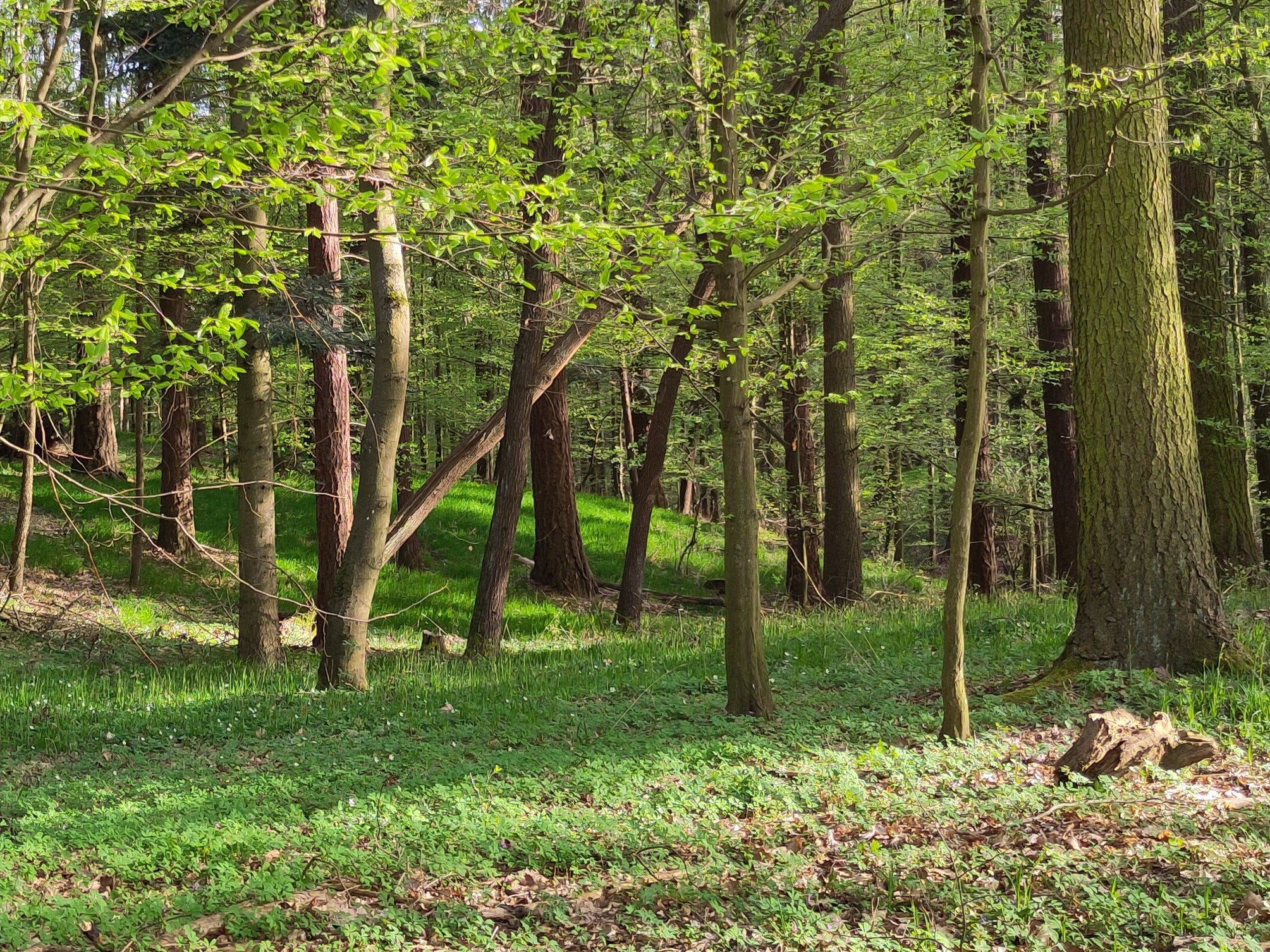
A few weeks later, I go for a walk through the forest with a friend and her young children. Going out with little children is quite an exercise of letting go. There is so much presence everywhere! This particular blade of grass, that amazing dry twig, all of these little stones that just ask to be thrown into the pond. The air in my nose is thick with the intense scent of the cherry and egg-plum trees in full blossom; the air in my ears vibrant with the buzzing of bees. The forest trail is wet, with puddles of water in the old tyre tracks. There are green remains of frog eggs here and there, but the water is mostly black. It’s a weird sight. We look more closely and sit on our knees in wonder: the puddle is one big teeming mass of swarming little tadpoles! They are just a few millimetres long, probably only recently hatched, but there are thousands and thousands of them. Everything is so passionately, abundantly alive! The vast majority of them will probably die in their infancy, long before becoming frogs. Life’s profusion puzzles me. To my wary self it seems such a waste. And so much unnecessary suffering. But maybe it’s generosity? An ultimate case of giving oneself up.
Giving up. Letting go.
Walking back home through the woods, some of the children’s wonder remains alive within me. The sun is beginning its descent towards the wooded hill behind my village. I realise how much I love it when sun is lower on the sky. It brings up the lushness in the leaves and creates an intricate dance of light and long shadows. And the little, fresh, soft leaves, which appeared on the trees just in the last week, dance along with them in an exquisite harmony. I pause in wonder and am overwhelmed by gratitude.
I take of my shoes, remembering Thich Nhat Hanh’s words about caressing the earth with each step. And thus I return to my dwelling place and I sit beneath the guardian Spruce in the corner of the garden to give this gift of wonder and gratitude to the place. And as I do, I notice again, as last time, how much more alive the place is. And for an instant it seems as if the place felt my gift and quivered with delight.
I remain there for quite some time, without thinking or intention, just gently giving my attention to all this abundance.
I have lost what elements of regular practice that I established in the first half of this inquiry. It didn’t feel right anyway, it was too planned, too ‘artificial’. I have reduced my practice to the bare minimum: turning up; paying attention. Isn’t that a form of invocation in itself, anyway?
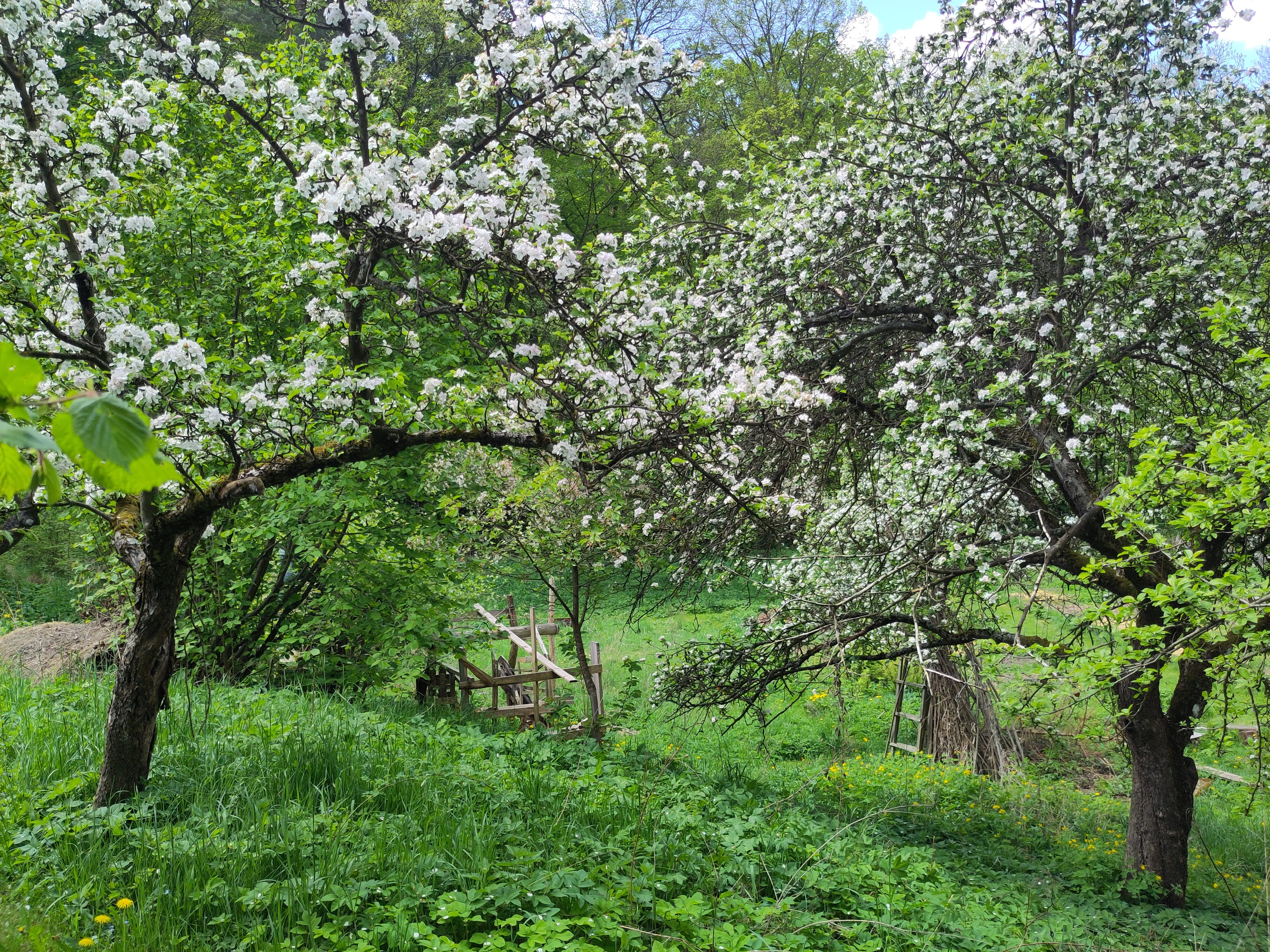
Meanwhile, the garden is busy becoming ever more abundantly alive. The myriad leafed beings covering the ground are stretching their lush, hungry leaves towards the sky, day by day getting closer and closer to the sun. Dozens of fruit trees are taking turns in assuming the role of a white petal queen. And the little wild flowers all around, inspired by them, also follow one another in showing off their subtle yet so lovely heads. Every day there is something new. Someone reaches the pinnacle of beauty and later gives way to another.
With all this going on, my clumsy tries at ‘invoking’ the live presence of the place seem so needless. Every morning, the incredible sunrise chorus of feathered singers invokes it instead with their ceremony. This is a ritual far more ancient than any of ours, than even our species. That is their gift and their responsibility: to sing the sun into rising every morning and awakening every place.
What are my gifts and thus responsibilities towards this place? So far, I hope my attention is enough. I still feel as such a fresh newcomer here. I need to spend all four seasons at least once here before allowing myself to become a more active member of this community of beings.
At least I have been giving my attention to the place aplenty lately. Nearly every day I go outside and spend some time with the trees and the little flowers. Anytime I’m away for a day or two, I’m missing the place and I’m eager to return as soon as possible, so as not to miss anything. Some of what the place is saying is crystal clear: an exuberant praise of life; a rich, sensuous, yet so divine desire to procreate.
Can I ever become so indigenous to this place as to really understand its voice?
Today, after a few weeks, I went again to my spot under the guardian Spruce in the corner of the garden. I want to spend some time there, with the Spruce, and also with the garden, and with the birds, last singers of the evening chorus. I pondered our whole inquiry and my attention returned back to the beginning, when I was exploring what a Dwelling place means for me and how can I become closer to my current one.
After a short meditation, a prayer just appeared on my lips, and I spoke it out loud.
You, Creek, who tirelessly nourishes the Land,
you, Spruce, who steadfastly guards the Land,
you, Linden, who creates a home on the Land,
you, Wild Plants, who lushly cover the Land,
you, Apple Trees, who give sweet gifts to the Land,
you, Air, who carries the songs of the Land,
you, Sun, who enlivens the Land,
you, Earth, the bones and flesh of the Land.

Let me become your neighbour,
your student,
your partner
let me become your dweller.

Let me grow roots here, too,
and perhaps help protect yours,
so that you all may enjoy this sanctuary
just a little while longer,
so that other may come after You and I,
and continue the long life-story
of this Land.
And I realised that one of the reasons I was struggling with this inquiry and with becoming close with the place was the perceived uncertainty. In the past couple of months, I feared for the future of the place. I have been trying to put together a group of people that would buy the place and become both its dwellers and guardians, so that it may never be built over. But it has been a struggle, and we are nowhere near this goal.
So I asked the Land and all its denizens for support in this endeavour.
But how can I know if it is even something the Land wants? Maybe it’s just me clinging to my idea (that is, to be honest, also the first opportunity in my life, to actually settle). Maybe I’m just being pretentious with my messianic urge to ‘save’ and ‘protect’ the Land. I don’t know. But the prayer helped me gain some measure of humility. Something heavy got lifted from me. I took in something of the not-clinging-to particular things, forms, even emotions. And I realised that this not-clinging is an attitude that might help me dwell better not only in the land, but also within me.
I should probably first ask the land to accept me and my friends. And we see when we go from there…