
Is the question of Fairies and Elves down by River a Zen koan?

I have been trying to think through the question Are There Elves and Fairies Down by River? I hold in mind Eleanor Robbins’, who urges us to see that the challenges of the present time call for ‘our deepest weirdness and our highest intellectual rigour’. Her point is that ‘aften nearly 500 years of shrunken consciousness’, our ways of seeing and inhabiting the world seem to be changing in significant ways, re-defining what is taken as real. And so:
to honour this expansion of consciousness that’s playing out inside each of us, we have to indulge our deepest weirdness; we have to get skilled at hearing the urgings of our instincts and subconsciouses… And we have to advance with absolute intellectual rigour. We have to bring the intellect along with us, meet its need for context and information and serious thought
Eleanor Robbins offers a delightful challenge:
Please, indulge your deepest weirdness and your deepest nerd. Seek out the serious thinkers and practitioners of the more-than-material realms. The people doing the research, the people whose imaginative capacity is matched by their rigour.[1]
Eleanor Robbin’s challenge is in line with the practice of co-operative inquiry: moving between experience and intellect is essential: new ideas may open up areas for experiential inquiry; and our experiences may be illuminated by ideas. This practice is at the heart of the Living Waters workshops. And so, as I wrote:
… it is all very well to read about ‘hidden beings’ and their ontological significance in a pluriverse, to accept this intellectually, but what might this notion mean if I explore it experientially?
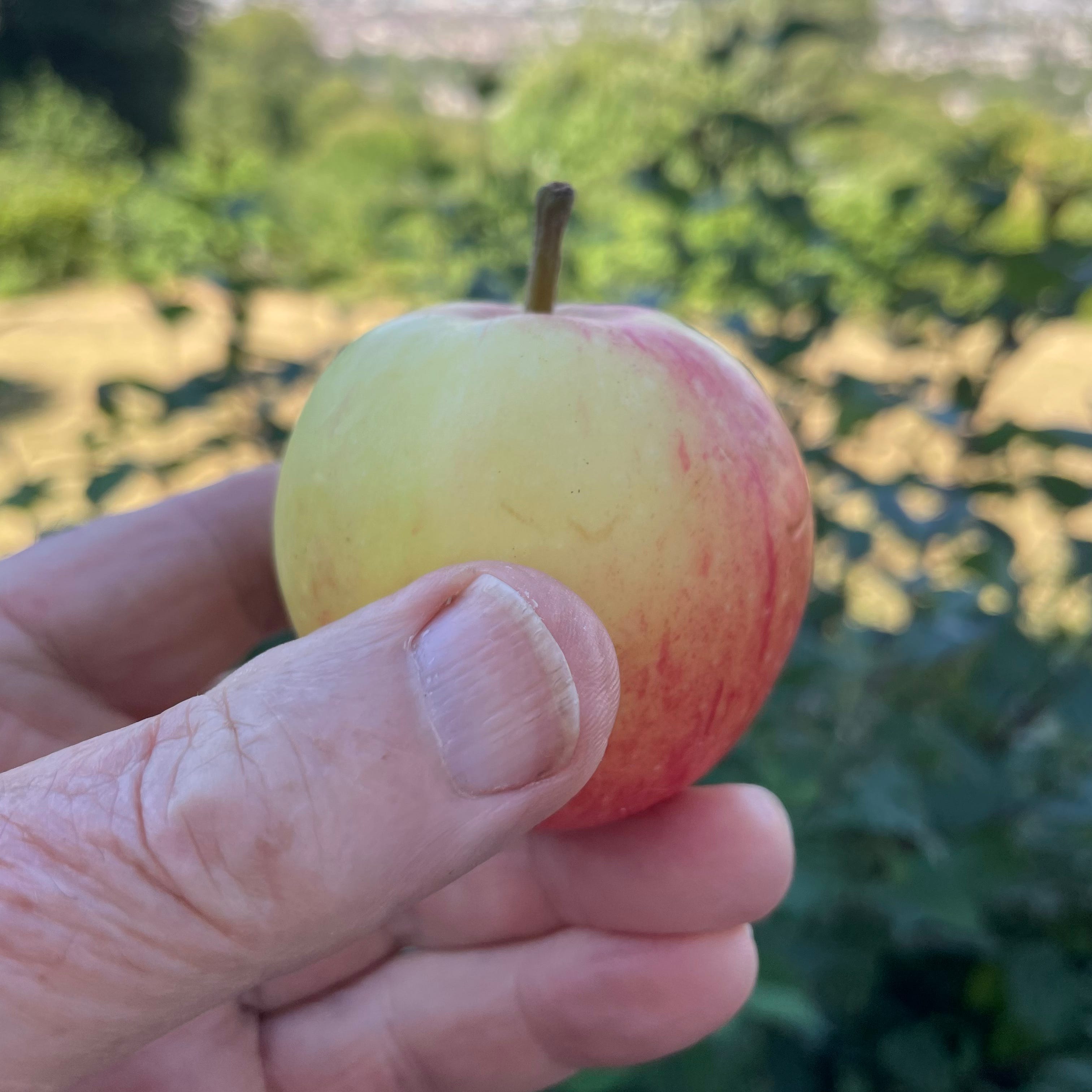
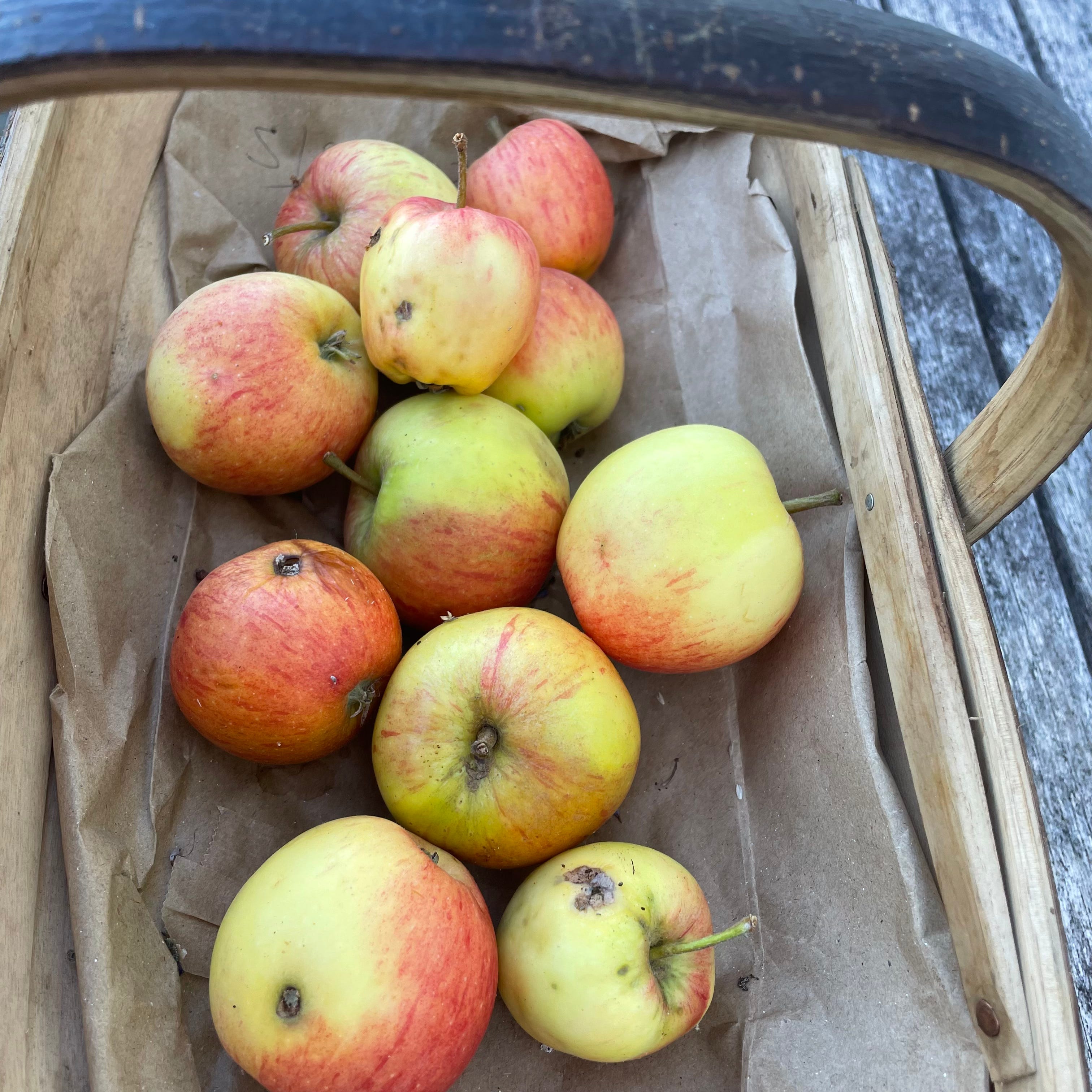
I have continued this experiential inquiry. For the Festival of Lammas (August 1) I took a freshly picked Reverend Wilkes apple from my Orchard as an offering to the hidden people. On this occasion they did not respond.
But what happens when we bring our ‘absolute intellectual rigour’ to bear on the presence of elves and fairies? There is a curious and necessary ambiguity about these beings. Once you start thinking about them it seems impossible not to imagine small beings with wings in flimsy dresses; or small gentlemen in green suits wearing pointy hats; or to tell oneself that this is ridiculous and that there is nothing to be seen. The idea of hidden persons, fairies and elves throws the rational mind into confusion, and in the ambiguity, new relations may arise.
As I bring my ‘deepest nerd’ to bear on this, I find myself wondering if the question has all the quality of a Zen koan, those puzzling and paradoxical questions and stories that are impossible to resolve with the rational mind. My dear departed friend, Chan Master John Crook, liked to see koans everywhere – in everyday life as much as on a Buddhist retreat. He describes the confrontation with a koan as being ‘thrown a ball I could not catch’;[2] and as a ‘signless signpost… stuck on top of a cliff’ pointing out to sea.[3] Koans are designed to stymy the rational mind, which is what the elves and fairies question does. It is only when we give up thinking that some resolution is available.
I will return to koan practice later, but first, let’s first accept the elves and fairies question at face value and ask, how can we understand the ontological status these hidden beings? In what ways can they be taken as ‘real’. They are, on the one hand, written off as wholly and dangerously weird, woo-woo, by modern western society – which leaves me with a certain nervousness about addressing them at all. On the other hand, they are seen by some as ‘real’, ‘magical beings’, even with an ‘oddly looking ears that point upwards’; or maybe as ‘nature spirits’ (and I have an aversion to both of those words, let alone the two in combination!).
Sadie Rittman holds this tension nicely. In her longer essay, which was written for an academic conference, she argues the importance of making space for “multiple, divergent worlds”. Elves and fairies
… are liminal figures within relational worlds. Inhabiting thresholds, they serve an inherently cosmopolitical function... They negotiate the human and more-than, and the bounds of our understanding, drawing us into relationship with a wider world beyond what we can claim to “know.”
And she goes so far as to say that elves and fairies carry an ‘epistemological technology’:
They are cross-cultural tools for holding many worlds, cultivating relational responsibilities, and contextualising us beyond the bounds of our comprehension.[4]
While for a more general audience in Orion Magazine, she writes
Belief cannot be wrangled… One does not have to believe to hold space for the unknown.... Maybe it’s time to once again acknowledge that ours is not the only world.’[5]
Once I had written my post Are There Elves and Fairies Down by River? I turned to my immediate colleagues, faculty on the Living Waters inquiry workshops, inviting their comments. I received several appreciative responses which suggested different ways of understanding.
Andreas Weber wrote
Wonderful. Animism is only complete if we acknowledge the existence of spirit beings. I always address them. The placeless, timeless dimension of felt beingness goes first, some of this comes manifest as bodies, but most doesn’t.
Freya Mathews writes that she has always enjoyed fairy lore and plays longstanding fairy games with my grandchildren. However,
Ontologically… I don’t see fairies or other spirit beings as having independent existence but rather as emergent responses of the living cosmos itself to our invocations - ‘emergent’ through just the kind of slant-glimpsed figurings and unusual ‘speaking’ natural phenomena that you’ve described. This kind of response is to my mind much more magical than the independent existence of particular spirit beings… But that’s just my way of making sense of these ancient traditions. I’m sure there are many other ways of doing so’.
Sandra Wooltorton comments from her perspective of kinship ecology and collaboration with Australian Indigenous Elders
‘… somehow it feels a bit like a threshold crossing for you… Yes, agreeing with Ria – the place knows and accepts you, and you recognise this now. But maybe you are still looking for separate things or ‘objects’ even though in a new way of seeing? Like Freya said, one way of seeing is - ‘emergent through just the kind of slant-glimpsed figurings’.’
Sandra continues to refer to rinyi, an aspect of kinship ecology described by Kankawa Nagarra, Walmatjarri Elder from Kimberley Country in north-west Australia, as a ‘language of place’. Other Australian Indigenous cultures speak similarly of lian, of experiencing Country directly through feeling.[6] Sandra writes:
You practically name the ‘rinyi’. You say: ‘It feels like there’s another dimension somewhere here, another layer of presence’. What if these beings and entities are perceived, felt, experienced but not-yet seen in the ‘rinyi’, because of the way of seeing?
Of these responses, I feel most affinity to Freya’s remarks; I agree with her that living cosmos panpsychism and ontopoetics make intelligible experiences that may see strange, without resort to the supernatural. I have experienced the poetic response of my call to the living world: swans and kingfishers have graced me with their presence, rain clouds have appeared, all at times and in ways that are apposite to my call. So why not elves and fairies as ‘emergent responses of the living cosmos’?
I am less certain of Andreas’ naming of ‘spirit beings’. As I mention above, I have long shied away from the word ‘spirit’ and the call to another, unseen dimension.
Sandra’s response is challenging. Yes, I suspect I am still looking for separate beings; yet I am uncomfortable taking on the term rinyi, which belongs so firmly to an Indigenous culture. I need to find my own ways of articulating how Land speaks to me.
So where does this take me? I feel I have got pretty close to indulging my ‘deepest weird’ by taking a bunch of meadow flowers and an apple down to River for the Elves and Fairies (and then writing about it). I need to do this more: the experiential inquiry has only just begun. But as I try to think this through, my rational brain is stymied.
And I am pretty sure that is the point. As Sadie Rittman puts it, fairies and elves are ‘liminal figures in relational worlds’ pointing to that which is beyond direct comprehension, ‘drawing us into relationship with a wider world beyond what we can claim to “know.”’ And this feeling of being stymied leads me back to my experience of learning through Zen koans.
At a koan retreat with the Western Chan Fellowship, we each had our koan to ‘solve’. John Crook as retreat director suggested that the first step should be to forget meditation and to attempt to resolve the koan with the rational mind. ‘Think about it from every possible angle’, he instructed us. We sat on our zafus and did as we were told, and for all our diligent efforts the koans completely defeated us. This thinking exhausts the rational mind, so that, as John put it, you have ‘cleared the ground a bit… but the question is still vividly there…’ As a next step, he instructed us”
…let the question come up, but don’t try to do anything with it at all, just let it come up, and kind of ‘do its own thing’. You’ve tried everything else… you’ve gone to the edge of your own thought… You are profoundly puzzled…
… allow it to come up, but don’t look at it anymore, just let it come up. The place to look is just in front of where it is arising, that’s where you should look and that’s the practise.[7]
What may happen as we do this? Whatever answer may come (if at all), either in a flash of illumination or a gradual emergence, it comes to a different kind of kind mind – not the reductive rationalism of the Western mind, but a mind more able to hold contradictory worlds at the same time. Maybe as Walt Whitman expressed it in Song of Myself:
Do I contradict myself?
Very well then I contradict myself,
(I am large, I contain multitudes.)
I think this koan practice applies just as much to the Elves and Fairies question as to a classic Zen koan. So I shall simply attend to the question without trying to answer it directly. Despite what Eleanor Robbins suggests, I think it may be time to give up on ‘absolute intellectual rigour’. Instead, I will continue my experiential inquiry of inviting ‘hidden people’ to be present with me by River, and then to let the Elves and Fairies play around in my mind.[8]
One approach to ‘allowing it to come up’ might be through the ‘presentational knowing’ of art and poetry, as I have already done by turning to Whitman.[9] Several times, while thinking through this essay I have found myself humming Sam Lee’s song, Green Mossy Banks, which carries a quality of feeling that moves me in a way I cannot fully describe:
When the land whispers
Don’t be a stranger
That irresistible call to come home
Ria Jago’s practice of listening to River and singing back the songs that arise offers a form of practice.[10] And I am indebted to my friend David Manzi Fe, who has been part of our panpsychic inquiry group since near the beginning, for offering me this ‘little (pseudo-Shakespearean) verse in response to my question:
In the half-light of dusk or dawn
sometimes see the secret form
of elf or gnome or fairy bright
shimmering in that magic light
where rock or grass or broken tree
flit into eyesight magic’ly
There lives the gentle trickster Puck
maybe seen with any luck
Glimpsed even with a sideways glance
Mind games inviting you to dance
Slipping through folk’s fingers then
Tarnished by the poems of men
Who may not realise at this juncture
With strange beliefs in their adventure
Are unable with their way of being
Fairies, Elves and Gnomies seeing
If wishing to communicate
Tis better now, before too late
To know themselves as honest friends
and in their hearts to make amends
For in this way they might just find
a way of loving their own kind.
At this point, I want to invite my dear readers into the conversation. What do you make of these tales of fairies and elves and other hidden people? I will avoid the word ‘real’ and ask in what ways are they present for you? Do you try to explain and understand them or maybe you are happy to accept that they are there, as Sadie Rittman puts it, ‘beyond direct comprehension’.
Can we start a reflective conversation without trying to pin down an answer?
[1] Eleanor Robbins (2024) This moment needs your deep weirdness and your intellectual rigour https://substack.com/@howtogohome/p-147612317
[2] Crook, J. H. (2009). The Koans of Layman John, Lulu Press. p.4.
[3] Exploring the use of koans in Chinese Zen. Talk given by John Crook at Koan Retreat in 1997. In Crook, J. H. (2019). Circling Birds. Redware Research Ltd, p.442.
[4] Sadie Rittman: The Cosmopolitics of Elves, Fairies, and Other Hidden Beings
[5] Sadie Rittman: Believing in Elves Orion Magazine, Winter 2005/2006. See

[6] Kankawa Nagarra Olive Knight, Anne Poelina and Sandra Wooltorton: Seeing, feeling, and hearing the world: A regenerative worldview: rinyi, pirlirr and liyan. See also Mathews, F. (2023). The Dao of Civilization: A Letter to China. Anthem Press, p. 57.
[7] Exploring the use of koans in Chinese Zen. Talk given by John Crook at Koan Retreat in 1997. In Crook, J. H. (2019). Circling Birds. Redware Research Ltd, p. 442.
[8] I do wonder – although this is beyond the scope of this post – whther the discipline of koan may go well beyond the questions addressed here to include contemporary theorists who attempt to conceptualise ‘multiple, divergent worlds’ or a ‘pluriverse’. I’m thinking here of Isabel Stengers, who Sadie Rittman references; and also to Escobar and his colleagues, whose book relationality is brilliant in parts but really fails to escape modern rationalism. This footnote critique is of course too sweeping and probably premature, requiring more mature consideration. Nevertheless, I think this is a useful direction for thought. I deeply miss the presence of my friend Jon Crook whose imaginative intellect would be able to address these issues in the context of both postmodern thought and the Buddhist Dama.
[9] See, for example, how visual art can hold open rather than close down wonder in the work of Luisa Brando, Stu McLellan, and Sara Mark.
[10] Jago, M. R. (2025). Song about Feeling: River-led relational practice for belonging with Country University Sunshine Coast]. Queensland, Australia. See also https://substack.com/@rialistening/note/c-215574356.
I love this...it so perfectly articulates a feeling I've been struggling to articulate. Thank you.
However...I often find myself torn in these conversations. I'm of Irish Traveller heritage, and so have family members that still very literally believe in fairies. The Fairy Faith is a still living tradition and one completely at odds with these new understandings. There is a tendency, among cultural elites, to take these traditions and make something different out of them, something more sophisticated and palatable, that conforms to a Western academic idea of Animism, that often doesn't reflect the reality.
The Fairy Faith would wholly caution against trying to see or experience these 'beings.' They are often malign, or at least wholly unimpressed with humans. They represent indifferent, even predatory other-than-human forces or intelligences. They bring disease (an early intuition of bacteria and viruses perhaps) they warn against disturbing the land. A literal belief in them has led to all sorts of atrocities, most notably around changeling belief, something I've written about before. This idea of seeking to experience them comes from the Celtic Revival, which was wholly elitist and condescending towards the rural classes whose folklore it appropriated and repurposed.
So...I'm torn. I wonder if we need new names.
Eleanor and I were together at the Kairos Spring Residency, and I appreciate being brought back together here in your work!
I like where you’re taking this. Elves tend to be tricksters, and tricksters are ontologically important . I absolutely see a similar role there to a koan.
In that sense, I doubt they’ll ever prove themselves to you in a cut and dry way. Instead, I expect this inquiry will take you on a very nonlinear journey far beyond what you might have expected. Just a hunch ;) prepare to get a little lost!